


How to Add a Permanent Gas Line for Your Outdoor Grill or Fire Pit in Ohio
The fastest way to eliminate propane tank refills and mid-cookout runouts is to install a permanent natural gas line directly to your outdoor grill, fire pit, or patio heater. In Ohio, the process involves a BTU load calculation, permit through your local building department, underground pipe installation to the correct burial depth, a pressure test, and a final inspection before the gas is turned on. This work must be performed by a licensed Ohio plumbing contractor and cannot be completed as a homeowner DIY project under the Ohio Fuel Gas Code. This guide covers everything you need to know to plan, permit, and install a permanent outdoor gas line in Northeast Ohio.
Why a Permanent Gas Line Beats Propane Tanks for Outdoor Cooking and Fire Features
Propane is convenient when a permanent gas connection is not available, but it comes with a list of management requirements that add friction to every outdoor cooking experience: monitoring tank levels, scheduling refills, hauling 20-pound cylinders, and running out of fuel at the worst possible moment. A permanent natural gas line connected to your home’s existing gas service eliminates all of that. Gas flows on demand, at the same steady pressure regardless of weather or tank level, and the supply is continuous for as long as you need it.
Natural gas also burns at a lower cost per BTU than propane in most Ohio markets and produces marginally cleaner combustion. For homeowners in Strongsville, Medina, Hudson, and throughout Northeast Ohio who already pay for natural gas service for heating, water heating, and cooking, extending that supply to the backyard is a practical investment that changes how you use your outdoor space. Summer in Northeast Ohio runs from June through September, and with peak temperatures reaching the upper 90s this week, outdoor entertaining season is at full intensity. There is no better time to install a permanent gas connection than right now.
What Goes Into a Permanent Outdoor Gas Line Installation
Step 1: BTU Load Calculation and Service Capacity Assessment
Every outdoor gas line installation begins with a BTU load calculation performed by the licensed plumber. This calculation determines how much gas your outdoor appliances will consume simultaneously and verifies that your existing interior gas service has sufficient capacity to supply both the indoor appliances and the new outdoor load without pressure drop. The Ohio Fuel Gas Code requires that when a gas appliance is added to an existing system, the existing piping must be checked to confirm it has adequate capacity for all appliances it serves. If the existing supply is insufficient, interior supply lines may need to be upgraded, or the utility may need to increase the meter capacity.
Typical BTU requirements for common outdoor appliances:
- Standard 2-burner outdoor gas grill: 30,000 to 60,000 BTU per hour
- 4-burner premium outdoor grill: 60,000 to 100,000 BTU per hour
- Gas fire pit or fire table: 50,000 to 150,000 BTU per hour
- Patio heater: 30,000 to 50,000 BTU per hour
- Outdoor pizza oven: 40,000 to 65,000 BTU per hour
- Full outdoor kitchen with multiple burners: 150,000 to 250,000+ BTU per hour combined
The pipe diameter selected for the outdoor run, typically 1/2 inch, 3/4 inch, or 1 inch, is determined by the BTU load and the length of the run. Longer runs require larger diameter pipe to deliver adequate flow without excessive pressure drop.
Step 2: Approved Materials for Ohio Outdoor Gas Lines
Ohio Admin Code 4101:8-24-01, which governs fuel gas piping in the state, approves several pipe materials for residential outdoor gas line installations, each suited to a different portion of the run. Your licensed plumber selects the appropriate material for each segment based on the installation conditions.
- Black steel (iron) pipe: Rigid, durable, and appropriate for above-ground exterior portions of the installation such as the stub-out at the house wall and any above-grade section near the appliance. Standard for above-ground residential gas service.
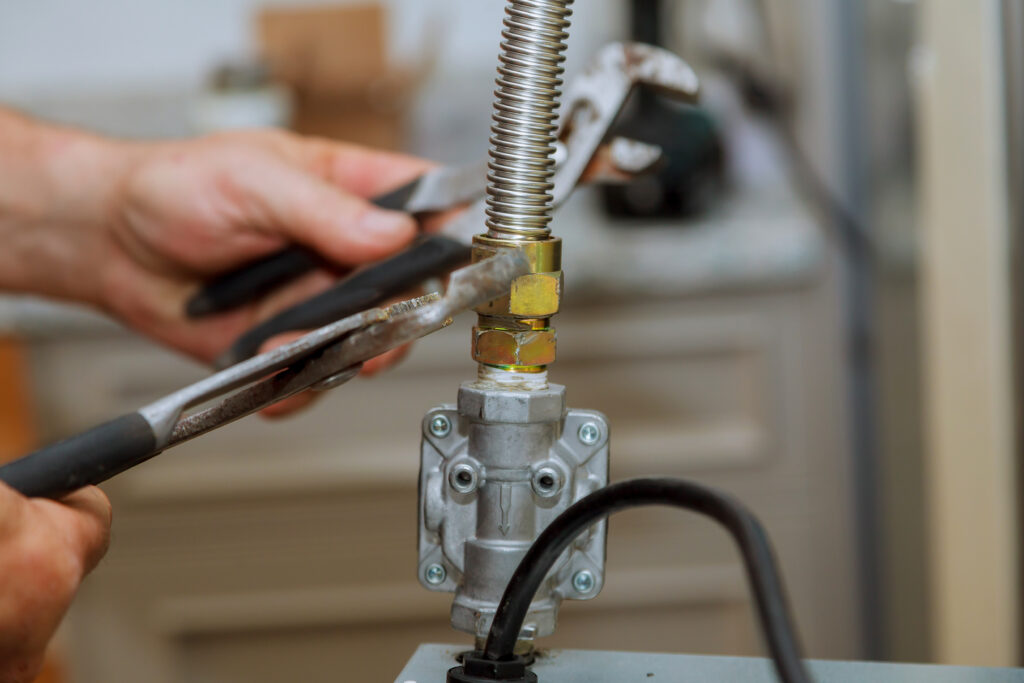
- Corrugated Stainless Steel Tubing (CSST): A flexible gas piping product that allows routing through walls and around obstacles more easily than rigid pipe. Approved for both above-ground and some below-ground applications. CSST must be properly bonded to the electrical service grounding electrode system per Ohio Admin Code 4101:8-24-01 to protect against lightning-induced surge damage.
- Yellow polyethylene (PE) pipe: Approved for direct burial in most residential applications. PE pipe is corrosion-resistant, flexible enough to handle soil movement, and is the most common choice for the underground run from the house to the outdoor appliance location.
Step 3: Underground Burial Depth Requirements
The International Code Council’s guidance on underground gas piping, adopted by Ohio, specifies a minimum burial depth of 12 inches for underground gas piping in areas not subject to vehicular traffic. An exception in the code permits supply lines for individual outdoor appliances to be installed at a minimum of 8 inches below grade, subject to Code Official approval and in locations not susceptible to physical damage. In areas beneath driveways or other vehicular traffic surfaces, the minimum depth increases significantly and the pipe typically must also be sleeved for protection.
In Northeast Ohio, where frost penetration can reach 24 to 36 inches during severe winters, Ohio Buckeye Plumbing typically recommends and installs outdoor gas lines at 18 to 24 inches of cover depth. This provides additional protection against frost heave and soil movement that can stress pipe joints over time, even in areas where the code minimum would allow less depth.
Step 4: Shut-Off Valve and Connection Fitting at the Appliance
Ohio code requires an accessible shut-off valve at each gas appliance, within approximately 6 feet of the appliance. For outdoor grill and fire pit connections, this typically takes the form of a gas ball valve or gas cock installed on the above-ground stub-out pipe at the appliance location, followed by a quick-connect gas fitting or direct hose connection to the appliance. The shut-off valve allows the gas supply to be completely closed at the appliance location when the appliance is not in use or when maintenance is needed.
Step 5: Pressure Testing and Inspection
Before any trench is backfilled or gas is turned on, the entire installed system must be pressure-tested. The licensed plumber applies test pressure to the system and verifies that all joints hold without leakage. After the test confirms integrity, the local building inspector performs a final inspection to verify that the installation complies with the Ohio Fuel Gas Code. Only after the inspection is approved and the inspector signs off can the gas be turned on and the appliance tested for operation. Ohio Buckeye Plumbing manages the inspection scheduling as part of every installation.
Ohio Permit Requirements for Outdoor Gas Line Installations
Any new gas line installation, extension, or modification in Ohio requires a building permit from the local jurisdiction. Ohio adopted its fuel gas code from the International Fuel Gas Code (IFGC), and Ohio homeowners are not legally permitted to install gas piping work themselves. The permit must be pulled by a licensed contractor holding an appropriate license from the Ohio Construction Industry Licensing Board (OCILB). In Strongsville, permits are issued through the Strongsville Building Department. For other Northeast Ohio communities, the local municipality or county building department handles permits.
Working without a permit creates legal liability for the homeowner, may void homeowner’s insurance coverage in the event of an incident related to the unpermitted work, and can create problems at the time of a home sale when the buyer’s inspector or title company discovers unpermitted gas work. Ohio Buckeye Plumbing handles the full permit application, inspection scheduling, and code compliance documentation as part of every outdoor gas line project.
DIY vs. Licensed Professional: Gas Line Work in Ohio
Ohio law does not permit homeowners to perform their own gas line installation, extension, or modification. Gas piping work must be performed by a licensed contractor. This is not a recommendation; it is a legal requirement under the Ohio Fuel Gas Code and Ohio OCILB licensing statutes. A licensed Ohio plumber brings not only the legal authorization to perform gas work but also the expertise to correctly calculate BTU loads, select appropriate materials, size pipe runs per NFPA 54 tables, perform pressure tests, and ensure that the CSST bonding requirements in Ohio Admin Code 4101:8-24-01 are fully met. Correctly installed gas piping provides decades of reliable service. Incorrectly installed gas piping creates ongoing risk that is disproportionate to any cost savings from attempting the work without proper licensing.
How Ohio Buckeye Plumbing Installs Outdoor Gas Lines in Northeast Ohio
- Site assessment: A licensed plumber visits the property, assesses the planned appliance locations, identifies the most practical route from the indoor gas supply, and calculates the BTU load and pipe sizing required.
- Service capacity check: Existing interior gas piping is assessed to confirm that adequate capacity is available for the outdoor addition. If upgrades are needed, those are identified and quoted before any work begins.
- Permit application: Ohio Buckeye Plumbing pulls the building permit through the local building department, handling all required documentation.
- Trenching: Underground run is excavated to the appropriate depth, typically 18 to 24 inches in Northeast Ohio to account for frost depth.
- Pipe installation: Yellow PE pipe is installed underground, transitioning to black steel or CSST at each end. Shut-off valve and appliance connection fitting are installed at the outdoor location. CSST is properly bonded to the building electrical ground.
- Pressure test: The complete system is pressure-tested before any trench is backfilled or gas is turned on.
- Inspection: Local building inspector reviews and approves the installation.
- Backfill and restoration: Trench is backfilled and graded. Lawn or landscape restoration is completed.
- Turn-on and appliance test: Gas is turned on, pressure and flow at the appliance are verified, and appliance operation is confirmed before the job is closed out.
Outdoor Gas Lines in Northeast Ohio: What Local Homeowners Should Know
Northeast Ohio’s outdoor season peaks from June through September, with summer temperatures frequently reaching the upper 80s and 90s in Strongsville and surrounding Summit County and Cuyahoga County communities. The region’s suburban neighborhoods, from Strongsville and Brunswick to Medina and Hudson, include a high proportion of homes with natural gas service that also have the yard space for permanent outdoor kitchen and fire feature installations. This is a growing segment of home improvement in the region, driven by the same desire for functional outdoor living space that defines suburban community in this part of Ohio.
Northeast Ohio’s freeze-thaw cycle, which can push frost down 24 to 36 inches in severe winters, makes proper burial depth critical for outdoor gas lines that will withstand decades of seasonal ground movement. Ohio Buckeye Plumbing’s licensed team is familiar with local soil conditions and installs outdoor gas lines to a depth that protects pipe joints against frost heave. For full outdoor kitchen installations that include multiple gas appliances as well as plumbing for an outdoor sink or prep area, our plumbing remodeling service coordinates both the gas and water supply elements of the project.
FAQs About Outdoor Gas Lines in Ohio
Can I connect a standard propane grill to a natural gas line in Ohio?
Most propane grills require a conversion kit to switch from propane to natural gas. The orifices inside a propane burner are different from those designed for natural gas because the two gases operate at different pressures and have different energy densities. Many grill manufacturers offer a natural gas conversion kit specific to their model, but not all propane grills are convertible. Before planning an outdoor gas line installation in Ohio, confirm with your grill manufacturer whether a natural gas conversion is supported and available for your specific model.
Do I need a permit to add an outdoor gas line in Ohio?
Yes. Under Ohio’s adoption of the International Fuel Gas Code, any new gas piping installation, extension, or modification requires a building permit from the local jurisdiction. In Strongsville, permits are issued through the Strongsville Building Department. Ohio homeowners cannot perform gas line work themselves; the permit must be pulled by a licensed Ohio contractor. The permit process also includes a required pressure test and inspection before the gas is turned on. Working without a permit creates legal liability and may affect homeowner’s insurance coverage.
How deep does an outdoor gas line need to be buried in Northeast Ohio?
The Ohio Fuel Gas Code, adopted from the International Fuel Gas Code, requires a minimum burial depth of 12 inches for underground gas piping in areas not subject to vehicular traffic. An exception allows supply lines for individual outdoor appliances to be installed at a minimum of 8 inches below grade, subject to Code Official approval and in locations not susceptible to physical damage. Under driveways or areas with vehicular traffic, greater depth is required. In Northeast Ohio, where frost penetration can reach 24 to 36 inches in severe winters, licensed plumbers often install outdoor gas lines at 18 to 24 inches to provide additional protection against frost heave and ground movement.
What size gas line do I need for an outdoor grill or fire pit?
Gas line sizing depends on the total BTU load of the outdoor appliances to be served, the length of the pipe run from the gas supply to the appliance location, and the operating pressure of the system. As a general reference, a standard two-burner outdoor grill typically requires 30,000 to 60,000 BTU per hour, a four-burner premium grill up to 100,000 BTU, and a gas fire pit or fire table 50,000 to 150,000 BTU. A licensed plumber performs a BTU load calculation and selects the appropriate pipe diameter based on the NFPA 54 sizing tables, ensuring adequate pressure and flow at the appliance.
How long does it take to install an outdoor gas line for a grill?
A standard outdoor gas line installation for a single grill or fire pit, involving a run of 30 to 60 feet from the house through the yard, typically takes one to two full days from permit submission to completed inspection. This includes permit processing, trenching, pipe installation, pressure testing, and backfill. More complex outdoor kitchen installations with multiple appliance connections, longer runs, or existing capacity limitations that require service upgrades may take longer. Ohio Buckeye Plumbing provides a timeline estimate before work begins.
What materials are approved for outdoor gas lines in Ohio?
The Ohio Fuel Gas Code approves several materials for outdoor gas piping. Black steel pipe (standard iron pipe) is commonly used for above-ground exterior portions. Corrugated Stainless Steel Tubing (CSST) is approved for both above-ground and some underground applications but requires proper electrical bonding to the building’s grounding electrode system as specified in Ohio Admin Code 4101:8-24-01. Yellow polyethylene (PE) plastic pipe is commonly used for underground runs because it is approved for direct burial and resistant to soil corrosion. Each material has specific installation requirements; your licensed plumber selects the appropriate material for each portion of the installation.
Can I install a gas line for an outdoor kitchen with multiple appliances at once?
Yes, and it is often more practical to plan the full outdoor kitchen gas system in one installation rather than adding appliances incrementally. A full outdoor kitchen may include a grill, side burners, a pizza oven, a patio heater, and a fire feature, each with its own BTU requirement. The licensed plumber calculates the aggregate BTU load, verifies that the home’s existing gas service meter and interior supply have sufficient capacity for the new outdoor load, and sizes the outdoor piping system to serve all planned appliances simultaneously. Ohio Buckeye Plumbing handles outdoor kitchen gas line installations throughout Northeast Ohio.
Is natural gas or propane better for outdoor grills and fire pits in Ohio?
For homes already connected to natural gas service, a permanent natural gas line is generally more convenient and cost-effective over time than propane for outdoor use. Natural gas is delivered continuously from the utility, so there is no tank to monitor, refill, or exchange. Natural gas also burns more cleanly at lower cost per BTU in most Ohio markets. Propane has a higher energy density per cubic foot and is the only option for properties without natural gas utility service. Many outdoor appliance manufacturers offer both natural gas and propane versions of the same product.
What is CSST and is it safe for outdoor gas line installations?
CSST, or Corrugated Stainless Steel Tubing, is a flexible gas piping product that allows installers to route gas lines through walls and around obstacles more easily than rigid black iron pipe. It is widely used in residential gas piping and is approved under the Ohio Fuel Gas Code. CSST must be properly bonded to the electrical service grounding electrode system to protect against damage from lightning-induced electrical surges. Ohio Admin Code 4101:8-24-01 specifies bonding requirements for CSST systems. When installed by a licensed plumber following all bonding requirements, CSST is a safe and code-compliant gas piping option.
Do outdoor natural gas lines need to be shut off during Ohio winters?
Outdoor gas appliances such as grills and fire pits should have their local shut-off valves closed when not in use, as a standard safety practice regardless of season. The gas line itself does not require seasonal shutdown for winter in Ohio. The buried underground portion of the installation is protected from freezing at the typical burial depth used for outdoor gas lines. Quick-connect fittings at the appliance connection point should be capped when the appliance is not in use to prevent debris entry into the connector. If you are storing a natural gas grill for the winter, close the shut-off valve at the stub-out location.
What is a quick-connect gas fitting and how does it work for an outdoor grill?
A quick-connect gas fitting (also called a gas disconnect or gas hose with quick-connect) is a gas-rated coupling device that allows an outdoor appliance to be connected and disconnected from the gas supply without tools, similar in operation to a garden hose connection. When the appliance hose is connected, the valve opens and gas flows. When disconnected, the valve closes automatically and no gas is released. Quick-connect fittings allow outdoor grills to be moved for cleaning, repositioning, or storage while maintaining a permanent gas stub-out in the yard. They must be rated for gas service and installed by a licensed plumber.
Who is responsible for the gas line on the property side of the meter?
The gas utility (such as Dominion Energy or Columbia Gas in Ohio) is responsible for the service line from the main to the meter and the meter itself. Everything downstream of the meter, including all interior piping and any exterior piping on the property, is the homeowner’s responsibility for maintenance and any upgrades. When adding an outdoor gas line, the homeowner contracts with a licensed plumber to design and install the extension from the existing interior supply through the house wall and out to the yard. The utility handles only the supply to the meter.
How do I know if my existing gas service has enough capacity for an outdoor addition?
A licensed plumber determines whether your existing gas service has sufficient capacity by calculating the total BTU load of all current gas appliances in the home (furnace, water heater, range, dryer) and adding the planned outdoor load. The calculation uses NFPA 54 sizing tables to verify that the existing meter, regulator, and interior supply pipe sizes can deliver adequate gas volume at the correct pressure to all appliances simultaneously. If the existing service is insufficient, the plumber may need to upsize interior supply runs or work with the utility to upgrade the service meter. Ohio Buckeye Plumbing performs this capacity assessment as part of every outdoor gas line consultation.
What is the permit process for an outdoor gas line in Strongsville or Northeast Ohio?
The permit process begins with the licensed plumbing contractor submitting a permit application to the local building department, which in Strongsville is the Strongsville Building Department. The application typically includes a site plan showing the proposed gas line route, the appliance BTU loads, and the pipe sizing. Once the permit is issued, work can begin. After installation, the licensed plumber performs a pressure test, and the local building inspector schedules an inspection to verify that the work complies with the Ohio Fuel Gas Code before the gas is turned on. Ohio Buckeye Plumbing manages the full permit process as part of every installation.
How do I schedule an outdoor gas line installation with Ohio Buckeye Plumbing?
Call Ohio Buckeye Plumbing at (440) 283-9377 or submit a service request online at ohiobuckeyeplumbing.com. We serve Strongsville, Medina, Brunswick, Akron, Hudson, Rocky River, Westlake, and all of Northeast Ohio. We are available for consultations and scheduling throughout summer. Every outdoor gas line installation begins with a site assessment, BTU load calculation, and upfront pricing before any permit is pulled or trench is dug. We are licensed through the Ohio Construction Industry Licensing Board, fully insured, and BBB-accredited with an A+ rating.
When to Call Ohio Buckeye Plumbing for Your Outdoor Gas Line
Ohio Buckeye Plumbing’s licensed plumbers design, permit, and install outdoor natural gas lines for grills, fire pits, patio heaters, outdoor kitchens, and pool heaters throughout Strongsville and all of Northeast Ohio. We are licensed through the Ohio Construction Industry Licensing Board, carry full general liability and workers’ compensation insurance, and hold an A+ BBB accreditation. Our outdoor gas line work is scheduled around your summer timeline, and we back every installation with a 100% satisfaction guarantee. Read verified customer reviews on Google and Angi before calling.
Schedule Your Outdoor Gas Line Installation in Northeast Ohio This Summer
Ohio Buckeye Plumbing is licensed, insured, and BBB-accredited with over 20 years of gas line service experience throughout Northeast Ohio. If you are ready to connect a permanent gas line to your outdoor grill, fire pit, or outdoor kitchen this summer, call (440) 283-9377 today for a free consultation and upfront pricing. We pull the permit, handle the inspection, and ensure your outdoor gas installation meets every requirement of the Ohio Fuel Gas Code. We are available 24/7 for gas line emergencies throughout Greater Cleveland, Medina County, Summit County, and the entire Northeast Ohio region.