


Drain Keeps Clogging Again After Being Cleared? Here Are the Real Reasons
If your drain has been cleared multiple times but keeps clogging back up within days or weeks, the problem is rarely something you did wrong, and snaking the drain a third or fourth time will not solve it. Standard drain snaking removes the blockage itself but leaves the underlying cause completely untouched. Grease and mineral scale coated on pipe walls, reduced pipe diameter from years of buildup, tree root regrowth, structural pipe defects like bellies or offset joints, and certain recurring habits all drive repeat blockages. A drain that keeps coming back is providing specific diagnostic information about the condition of your pipes. Understanding what that information means determines whether the lasting fix is hydrojetting, a camera inspection, trenchless relining, or simply a change in drain habits.
What Makes a Drain Clog “Recurring”?
A recurring drain clog is not the same as a drain that happens to clog twice. It is a pattern: the drain is professionally cleared, functions normally for a short period, then backs up again without any clear change in how the drain is being used. The return timeline is the most important indicator of the underlying cause. A clog that comes back within 1 to 2 weeks of professional snaking almost always points to a structural or material condition in the pipe. A clog that comes back within 1 to 2 months typically indicates incomplete cleaning, with grease or scale still coating the walls after snaking. When a drain has been cleared three or more times in a single year and the pattern continues, it is time to stop treating the symptom and identify the actual cause.
The 7 Real Reasons Your Drain Keeps Clogging Back
1. Snaking Punches Through the Clog but Does Not Clean the Pipe
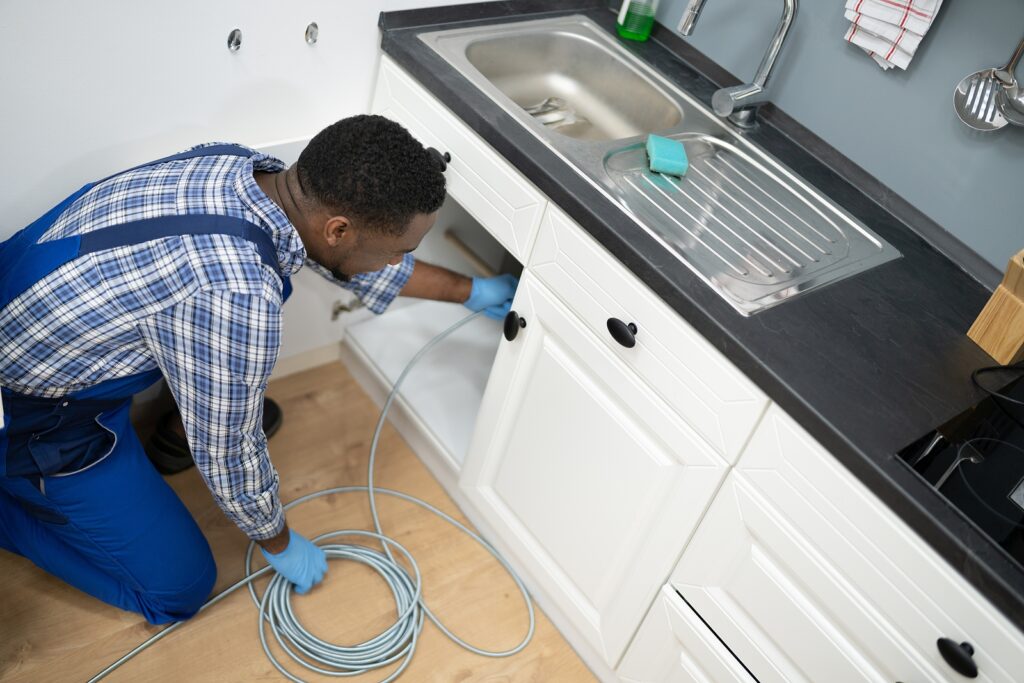
This is the most common reason a cleared drain clogs again quickly. A drain snake, also called a cable machine or auger, works by pushing a rotating cable through the blockage to create an opening. It does not remove the buildup on the pipe walls themselves. Grease coating the walls of a kitchen drain, mineral scale deposited by hard water, and soap scum accumulation in bathroom pipes are all left behind after the snake passes through. Because the walls are still coated, a new clog forms faster than it would in a clean pipe. Our blog on the difference between drain snaking and hydrojetting explains this distinction in detail. Hydrojetting, which uses high-pressure water to scour the pipe walls, is the method that addresses what snaking leaves behind.
2. Mineral Scale Is Reducing Your Drain’s Effective Flow Diameter
Hard water deposits calcium and magnesium on the interior walls of pipes in the same way it coats the inside of a water heater. In Northeast Ohio, particularly in communities served by Medina County’s groundwater aquifer system, water mineral content is elevated compared to treated Lake Erie surface water. This scale builds up gradually, reducing the effective interior diameter of the drain pipe over 10 to 20 years of use. A 4-inch drain pipe with significant scale accumulation on all interior walls has measurably less flow capacity, catching debris that would pass through a clean pipe with room to spare. The Northeast Ohio Regional Sewer District and regional infrastructure assessments consistently identify mineral scale as a contributing factor in drain performance degradation throughout the region’s aging housing stock.
3. Tree Roots Are Growing Back After Being Cut
When a drain snake or root-cutting blade removes roots from a sewer lateral, it cuts the root mass inside the pipe. But the root system itself is still alive and growing from outside the pipe. New root tips re-enter through the same crack or joint gap within weeks to months, depending on the tree species and the season. Northeast Ohio’s high annual rainfall and the mature tree canopy throughout residential neighborhoods from Strongsville and Brunswick to North Royalton and Barberton make tree root intrusion one of the most common causes of recurring drain clogs in the region. Our Roots Be Gone treatment service applies a professional foaming product that kills root tissue at the point of entry and discourages regrowth, providing longer-lasting results than mechanical cutting alone.
4. A Pipe Belly Is Creating a Permanent Low Point Inside the Drain
A pipe belly occurs when a section of drain line settles lower than the surrounding pipe due to soil movement, foundation shifting, or improper installation slope. Water and waste slow at the low point, debris accumulates there, and a clog forms. A drain snake clears the accumulated material from the belly, but it cannot change the physical geometry of the pipe. The belly refills predictably because the low point still exists. A pipe belly is only diagnosable with a video camera inspection and the fix is either relining the pipe to restore the interior surface, or replacing the sagging section.
5. An Offset Joint or Cracked Pipe Interior Is Catching Debris
An offset joint occurs when two sections of pipe have shifted out of alignment, creating an interior ledge or raised lip inside the pipe. Debris flowing through the drain catches on this ledge and accumulates there repeatedly. Each time the drain is cleared, the ledge is still in place, and the next wave of debris catches in exactly the same spot. A cracked pipe section with an irregular interior surface produces the same effect. Neither of these conditions is detectable by snaking or visible from outside the pipe. A video camera sewer inspection identifies the precise location and nature of the defect and determines whether relining or targeted repair is appropriate.
6. Recurring Behavioral Habits Are Rebuilding the Clog
Sometimes a drain keeps clogging because the same materials are being introduced to it regularly, creating conditions where a new blockage forms each time. Kitchen drains that receive cooking grease or oil will re-clog because grease re-coats the walls after each clearing. Bathroom drains without hair catchers will re-clog from accumulated hair. Drains in homes where wipes labeled “flushable” are used will develop recurring blockages because these products do not break down in drain systems despite the labeling. Behavioral causes can closely mimic structural problem patterns, and identifying them correctly avoids unnecessary repair work.
7. An Undersized Drain Pipe Cannot Handle the Current Demand
Some Northeast Ohio homes built before 1960 have original 2-inch drain lines in locations where modern plumbing code requires 3-inch or larger pipes. A 2-inch kitchen drain serving a garbage disposal, dishwasher connection, and main kitchen sink simultaneously may lack the physical capacity to handle the combined flow without frequent clogging. Snaking this type of drain provides only temporary relief because the pipe is working at or beyond its designed capacity with every normal use. Our general plumbing services include drain line assessment and upgrade work for homes where undersized pipe diameter is the root cause of recurring clogs.
Warning Signs That Snaking Alone Is Not the Right Solution
- The drain clears completely but backs up again within 1 to 2 weeks
- The same drain has been snaked three or more times in a single year
- Multiple drains throughout the home are slow at the same time
- Gurgling sounds come from other drains or toilets when one fixture is in use
- Sewage odors are present near floor drains or in the basement
- Water drains slowly on all levels of the home, not just from one fixture
- The drain issue began shortly after tree service work in the yard, suggesting disturbed root systems
DIY Drain Maintenance vs. When You Need a Plumber
What DIY can genuinely help with:
- Enzyme-based drain cleaners used monthly to break down organic buildup in drain walls (not chemical cleaners, which can damage older pipe materials common in Northeast Ohio homes)
- Hair catchers and drain strainers on all bathroom drain openings
- Avoiding grease, oil, coffee grounds, and fibrous food waste in kitchen drains
- Never flushing wipes, paper towels, or non-organic materials
- Running hot water for 30 seconds after each kitchen drain use to help carry grease through before it cools
What DIY cannot address:
- Structural pipe conditions including bellies, offset joints, and cracked pipe interiors
- Tree root intrusion (roots return after chemical treatments alone)
- Mineral scale buildup on pipe walls (requires professional hydrojetting)
- Undersized drain pipe capacity issues
The Ohio EPA maintains water quality and infrastructure standards for the region, and any sewer lateral repair or replacement work in Ohio is subject to local building permit requirements and must be performed by licensed contractors.
Solutions That Actually Fix Recurring Drain Clogs
Professional Hydrojetting
Hydrojetting introduces water at high pressure through a specialized nozzle inserted into the drain from a cleanout access point. The pressure and flow scour the pipe walls completely, removing grease coating, mineral scale, biofilm, and soft root material, restoring near-original flow capacity. Unlike snaking, hydrojetting cleans the cause rather than just the symptom. For any drain that has been snaked three or more times in a year without lasting results, hydrojetting is the appropriate next step. Ohio Buckeye Plumbing’s hydrojetting service is available for both residential and commercial properties throughout Northeast Ohio.
Video Camera Sewer Inspection
Before committing to any major drain repair, a video camera sewer inspection tells you exactly what you are dealing with. The camera enters the pipe from a cleanout and provides real-time footage of the pipe interior, identifying the blockage location, root presence, pipe belly, offset joints, cracked sections, and the condition of the pipe material. Ohio Buckeye Plumbing always shows customers the inspection footage before recommending any repair so they understand exactly what was found and why the recommended solution addresses it. Our blog on how video inspections prevent unnecessary excavation explains the diagnostic process in detail.
Root Removal and Roots Be Gone Treatment
For drains with confirmed tree root intrusion, mechanical root cutting followed by a Roots Be Gone foaming treatment provides longer-lasting results than cutting alone. The foaming product penetrates root tissue at the point of entry and inhibits regrowth for up to a year or more. Combined with a camera inspection to assess whether the entry point can be sealed by pipe relining, this approach stops the recurring pattern for many Northeast Ohio homeowners.
Trenchless Pipe Lining
When a structural pipe condition (belly, offset joint, root entry points, cracked section) is confirmed by camera inspection, trenchless pipe lining installs a seamless epoxy liner inside the existing pipe through cleanout access points without excavation. The liner seals cracks, joint gaps, and root entry points, and restores the interior of the pipe to a smooth surface. Trenchless lining eliminates the physical conditions that drive recurrence and extends pipe service life by decades. Our sewer line repair and replacement service includes both trenchless and traditional excavation options depending on pipe condition and depth.
Why Northeast Ohio Homes Experience Recurring Drain Clogs More Frequently
Northeast Ohio homeowners face a convergence of factors that makes recurring drain clogs more common here than in many other U.S. regions. Hard water from Medina County’s groundwater aquifer system and the mineral content of Greater Cleveland’s water distribution infrastructure accelerates mineral scale buildup on pipe walls. The aging housing stock throughout the region, including Maple Heights, Euclid, Lakewood, Cleveland Heights, and surrounding communities, often has original cast iron drain lines from the 1950s and 1960s that have accumulated decades of scale and corrosion. And the mature tree canopy throughout the residential neighborhoods of Strongsville, Brunswick, North Royalton, and similar communities provides abundant root systems for which aging clay and cast iron sewer laterals provide easy access. The NEORSD manages much of the regional sewer infrastructure in Cuyahoga County, and homeowners with recurring lateral issues may also qualify for available cost-savings or inspection programs through the district.
FAQs About Recurring Drain Clogs
Why does my drain keep clogging even after being professionally snaked?
Standard drain snaking creates an opening through the blockage but does not remove the buildup on the pipe walls themselves. Grease coating, mineral scale from hard water, and biofilm remain after the snake passes through. The pipe walls are still coated, so a new clog forms faster than it would in a clean pipe. The lasting solution requires hydrojetting to scrub the pipe walls, combined with a video camera inspection if the clog keeps returning after hydrojetting.
What is hydrojetting and how is it different from drain snaking?
Snaking uses a rotating cable to punch an opening through a blockage. Hydrojetting uses high-pressure water delivered through a specialized nozzle to scour the interior walls of the drain pipe, removing grease, scale, biofilm, and soft root material completely. The results of a proper hydrojetting service last significantly longer than snaking because it removes what snaking leaves behind on the pipe walls. Ohio Buckeye Plumbing offers hydrojetting for both residential and commercial properties throughout Northeast Ohio.
How do I know if I need a video camera inspection of my drain or sewer line?
A video camera inspection is the right step when a drain has been cleared three or more times in a calendar year, when multiple drains throughout the house are slow simultaneously, when gurgling sounds come from other fixtures when one drain is used, or when sewage odors develop in the basement or lower level. The camera identifies structural causes like pipe bellies, offset joints, root intrusion, and cracked pipes that snaking cannot detect and that explain why the clog keeps returning.
Can tree roots grow back into my drain line after being cut?
Yes. Mechanical root cutting removes the root mass inside the pipe but does not kill the living root system growing from outside the pipe. New root tips re-enter through the same crack or joint gap within weeks to months, depending on the species and growing season. Applying a Roots Be Gone foaming treatment after cutting kills the root tissue at the point of entry and significantly slows regrowth. For a permanent solution, a video camera inspection determines whether the pipe can be relined to seal the entry points entirely.
What is a pipe belly and how does it cause my drain to keep clogging?
A pipe belly is a section of drain line that has settled lower than the surrounding pipe due to soil movement, shifting foundations, or improper installation slope. Water and waste slow at the low point, and debris accumulates there instead of flowing to the main sewer. Snaking clears the accumulated debris, but the belly refills within days because the physical geometry of the pipe is unchanged. A pipe belly is only diagnosable with a video camera inspection and the fix is trenchless pipe relining or replacement of the sagging section.
Are chemical drain cleaners making my recurring clog problem worse?
Chemical drain cleaners provide temporary relief by dissolving organic material at the point of the clog, but they do not clean pipe walls and they can damage older pipes over time. Cast iron drain lines common in Northeast Ohio homes built before the 1960s, and PVC pipes connected with older fittings, can be degraded by repeated use of caustic chemical cleaners. For recurring clogs, enzyme-based cleaners used monthly as preventive maintenance are a safer choice, and professional hydrojetting is the only method that cleans the pipe walls themselves.
How long do the results of a professional hydrojetting service last compared to snaking?
The results of a properly performed hydrojetting service typically last significantly longer than snaking, because hydrojetting removes the grease coating and mineral scale from the pipe walls rather than just clearing a channel through a blockage. For kitchen drains with grease buildup and no structural issues, the results of hydrojetting can last 1 to 3 years with normal maintenance habits. For pipes with root intrusion or structural conditions, follow-up camera inspection and treatment scheduling is part of Ohio Buckeye Plumbing’s service recommendation.
What is mineral scale and how does it cause drain problems in Northeast Ohio?
Mineral scale forms when calcium and magnesium in hard water deposit on the interior walls of pipes. In Northeast Ohio, Medina County’s groundwater aquifer system produces water with elevated mineral content compared to Lake Erie surface water. This scale builds up gradually on pipe walls, reducing the effective interior diameter of the drain over years. A drain that once flowed freely becomes increasingly prone to clogging as its capacity shrinks. Hydrojetting removes mineral scale from pipe walls and is the only practical method for restoring diameter in a scale-coated drain.
What should I never put down the drain to help prevent recurring clogs?
The most common recurring-clog contributors are cooking grease and oil (let cool and dispose in the trash instead), coffee grounds, fibrous foods like celery and asparagus, eggshells, “flushable” wipes (which are not actually drain-safe despite the label), paper towels, hair in bathroom drains (use a drain hair catcher), and any non-organic material that does not dissolve in water. Addressing these behavioral factors alongside professional drain cleaning prevents a structural-cause clog from being compounded by recurring organic buildup.
Can the drain pipe in my older Northeast Ohio home be too small for current drainage needs?
Yes. Some Northeast Ohio homes built before the 1960s have 2-inch drain lines in locations where modern plumbing code calls for 3-inch or larger pipes. A 2-inch kitchen drain serving a garbage disposal, dishwasher connection, and main sink simultaneously may simply lack the capacity to handle the combined load without frequent clogging. Snaking provides only temporary relief for an undersized pipe. Ohio Buckeye Plumbing can assess existing drain line sizing and recommend whether a pipe upgrade is the most practical long-term solution.
How does hard water in Northeast Ohio cause drains to keep clogging?
Hard water mineral scale deposits accumulate on the inside walls of drain pipes at a rate that depends on the mineral content of the water supply. In Medina County communities served by groundwater aquifers, and in homes throughout Greater Cleveland with elevated water hardness, this scale builds up over 10 to 20 years to significantly reduce drain capacity. A pipe that started with a 4-inch interior diameter can lose a meaningful fraction of that capacity to scale, catching debris more readily and clogging more frequently. Hydrojetting is the most effective method for removing this scale.
When does a recurring drain clog mean I need to replace my sewer line entirely?
Sewer line replacement becomes the recommendation when a video camera inspection reveals that the pipe wall has been compromised: cracked sections, collapsed segments, extensive joint separation, or a pipe belly that cannot be addressed by relining. When the pipe material is in good structural condition and only the joints or interior surface are the problem, trenchless relining is often a cost-effective alternative to full replacement. Ohio Buckeye Plumbing always shows customers the camera footage and presents both options clearly before recommending a course of action.
Is it normal for a drain to clog again within two weeks of professional snaking?
No, it is not normal. A drain that clogs again within two weeks of professional snaking has an underlying condition that snaking did not address. This timeline points toward a structural issue like a pipe belly, offset joint, or root intrusion, a significant grease coating on the pipe walls that was not cleaned by the snake, or an undersized drain section. Two weeks is a red flag that the standard snaking approach is not the right solution for this specific drain, and a camera inspection is the appropriate next step.
How often should drains be professionally cleaned to prevent recurring clogs?
For most residential drains in Northeast Ohio homes, professional drain cleaning every 1 to 2 years as a maintenance measure keeps pipes clean and prevents the buildup pattern that leads to recurring clogs. Homes with hard water, older cast iron drain lines, or confirmed tree root intrusion may benefit from annual professional cleaning. Kitchen drains in households that cook frequently with oils and fats may need attention more often. Ohio Buckeye Plumbing can recommend a maintenance schedule based on your home’s specific drain conditions.
What does Ohio Buckeye Plumbing do differently when a drain keeps coming back?
When a drain keeps recurring after standard clearing, Ohio Buckeye Plumbing recommends starting with a video camera inspection rather than simply snaking again. The camera identifies the specific cause: pipe scale, tree root intrusion, pipe belly, offset joint, or another structural condition. Based on the inspection findings, we recommend the appropriate solution, which may be hydrojetting, root cutting and Roots Be Gone treatment, trenchless relining, or pipe repair. We show customers the camera footage before recommending any repair and provide upfront pricing on every option.
When to Call Ohio Buckeye Plumbing About Your Drain
When a drain keeps coming back after standard clearing, Ohio Buckeye Plumbing has the camera inspection equipment, hydrojetting technology, and root treatment expertise to identify the specific cause and fix it correctly. Our licensed, insured plumbing team serves all of Northeast Ohio and approaches every recurring drain problem with a diagnostic-first commitment. We are BBB-accredited, carry full insurance, and stand behind every job with a 100% satisfaction guarantee. Read verified customer reviews on Google and HomeAdvisor before scheduling.
Schedule a Drain Inspection or Hydrojetting Service in Northeast Ohio
Ohio Buckeye Plumbing is licensed in compliance with Ohio OCILB standards, fully insured, and BBB-accredited, with over 20 years of drain cleaning and sewer service experience in Greater Cleveland and Medina County. If your drain keeps clogging no matter how many times it is snaked, the answer lies in what snaking cannot see or remove. Call (440) 283-9377 for a camera inspection, hydrojetting evaluation, or rooter service call. We operate 24/7, deliver upfront pricing before any work begins, and stand behind every service with a 100% satisfaction guarantee.