


Water Heater Leaking From the Bottom? Do This Before Calling a Plumber
A water heater leaking from the bottom does not automatically mean the unit needs to be replaced. The cause matters. Ohio Buckeye Plumbing is licensed by the Ohio Construction Industry Licensing Board (OCILB), carries full general liability and workers’ compensation insurance, and holds an A+ accreditation with the Better Business Bureau. With more than 20 years of water heater service throughout Northeast Ohio, our team diagnoses the source of every bottom leak before recommending a course of action. There are four possible causes, and three of them have repairs that cost far less than a full replacement. Read verified reviews on Google, Angi, and HomeAdvisor. Call (440) 283-9377 for same-day service.
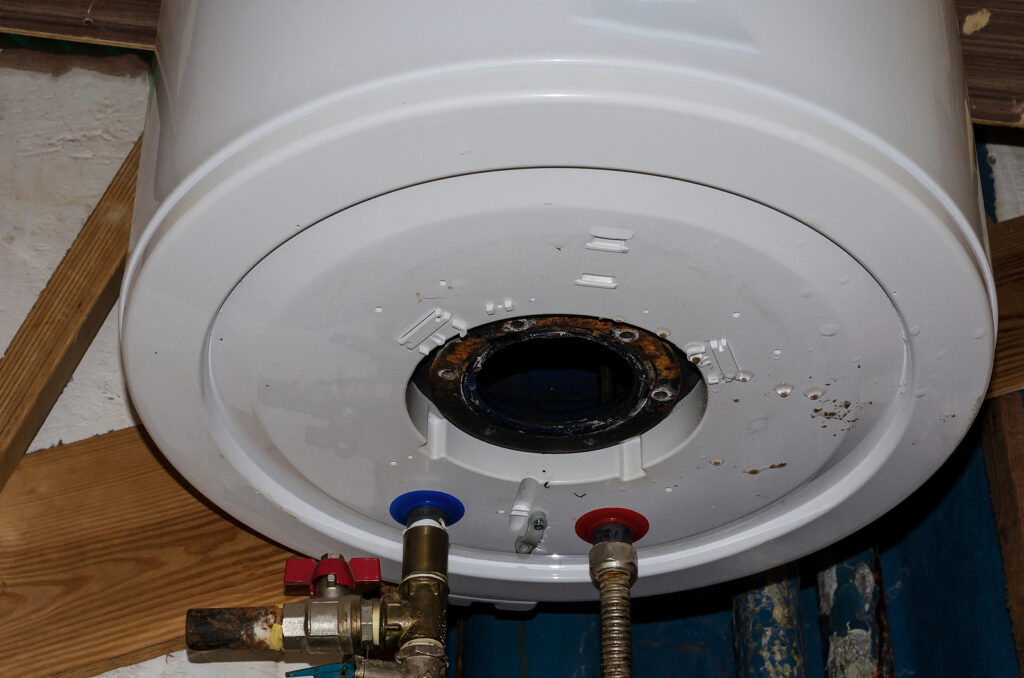
Do This First: Securing Your Water Heater Before Help Arrives
Before trying to diagnose the source or calling a plumber, two steps protect your home and allow a safer assessment:
- Turn off the power or gas supply: For electric water heaters, locate the dedicated circuit breaker and switch it off. For gas water heaters, turn the gas valve on the supply line to the pilot or off position.
- Turn off the cold water supply: Locate the cold water inlet valve on the pipe entering the top of the unit. Close it fully by turning it clockwise. If the valve is stuck or not accessible, close the main water shutoff for the home temporarily.
Once those two steps are done, place towels or a container to catch dripping water. Do not attempt to drain the full tank or disconnect gas lines. Then call Ohio Buckeye Plumbing’s water heater service team at (440) 283-9377 to describe the situation. Our team will advise on priority and schedule service.
The 4 Sources of a Water Heater Bottom Leak: What Each Means
1. The Drain Valve: Most Common, Least Serious
The drain valve is the threaded fitting at the very bottom of the water heater tank, used for draining the unit during maintenance or replacement. It is the most common source of a bottom water heater leak and the one most likely to be resolved with a simple repair rather than full unit replacement.
Drain valve leaks typically appear as a steady slow drip directly below the valve fitting. They most often occur because the valve has not been fully closed after a previous draining, the washer inside has deteriorated over years of water contact, or the valve has developed scale deposits around the seal from mineral-rich water. A loose plastic drain valve can sometimes be stopped by gently tightening it clockwise, but overtightening a plastic valve can crack it. A corroded or non-closing drain valve is replaced as a standard repair. This does not require a full water heater replacement. Ohio Buckeye Plumbing carries common replacement drain valves on service trucks for same-visit repair. Our blog on how sediment buildup affects water heater performance explains why mineral accumulation at the drain valve is more common in older units.
2. The T&P Valve Discharge Pipe: Requires Diagnosis
The temperature and pressure (T&P) relief valve is a critical safety component on the side of the water heater tank. Its discharge pipe runs down toward the floor or terminates near a drain. When this pipe releases water, it may look like a bottom leak even though the origin is on the side of the unit. A T&P valve that releases water periodically is doing its job of venting excess pressure, but repeated releases indicate that something in the system is driving pressure beyond safe operating limits. This could be an undersized or failed expansion tank, high incoming supply pressure, or a T&P valve that has reached the end of its service life. Our blog on whether your home needs a water heater expansion tank covers why expansion tanks are a key part of controlling system pressure in closed plumbing systems. A T&P valve that is actively releasing should be assessed by a licensed plumber rather than capped or bypassed.
3. Condensation: Not a Leak at All
Condensation can produce moisture at the base of a water heater that resembles a leak, particularly on new gas units during initial heat-up and during Ohio’s humid summer months. When a cold water supply enters a tank surrounded by warm, humid air, moisture condenses on the exterior tank surface and may drip to the floor. Condensation typically produces a general film of moisture across the lower tank exterior rather than a steady drip from a specific point, and it disappears once the tank reaches operating temperature. If the moisture is gone after the unit has run for a few hours, condensation was the cause and no repair is needed. If the moisture is a consistent drip returning from a specific location, further inspection is needed.
4. The Tank Itself: Replacement Is Required
If water is seeping from the seam at the base of the tank, appearing at welds on the tank body, or pooling beneath the unit in a pattern that cannot be traced to any valve or pipe connection, the tank has experienced internal corrosion that has reached the outer shell. When the steel inner lining fails due to years of water contact and sediment accumulation, the tank cannot be repaired. Replacement is the only permanent solution. The U.S. Department of Energy notes that conventional tank water heaters last approximately 10 to 15 years. A unit approaching this age with a confirmed tank leak is typically better served by replacement than by any attempted patch. Ohio Buckeye Plumbing provides new tank and tankless water heater installation throughout Northeast Ohio with same-day or next-day availability in most cases.
How to Tell Which Source Is Causing Your Leak
Use this approach to narrow down the source before calling for service:
- Dry the entire exterior of the tank with a cloth.
- Stand back and watch where moisture first reappears.
- If it appears specifically at the bottom valve fitting: drain valve leak.
- If it appears at a pipe running down from the side of the unit: T&P discharge.
- If it appears as a general film across the lower tank in high humidity: likely condensation.
- If it appears from the tank body itself with no connection to a specific valve or pipe: tank corrosion.
Describe what you observe when you call Ohio Buckeye Plumbing at (440) 283-9377. This helps our team arrive prepared with the right parts and assessment tools for your specific situation.
Water Heater Age and What It Means for Your Repair Decision
A water heater’s age is one of the most important factors in the repair vs. replace decision. The U.S. Department of Energy estimates a 10-to-15-year service life for conventional tank units under typical operating conditions. Units in areas with hard water or high sediment content often experience shorter service lives because sediment accumulation accelerates corrosion of the tank’s inner anode rod and lining. Our blog on how hard water shortens water heater life covers the specific mechanisms at work. A 12-year-old tank with a failed drain valve may still justify replacement rather than repair if the tank interior is likely compromised. A 4-year-old unit with a dripping drain valve almost always justifies the repair. Ohio Buckeye Plumbing provides an honest assessment of both the repair and replacement scenarios with upfront pricing before any work begins.
When to Treat Your Water Heater Leak as an Emergency
Call Ohio Buckeye Plumbing’s emergency line at (440) 283-9377 without waiting if:
- Water is actively flowing rather than dripping, indicating a valve that has fully failed or a tank that is discharging volume rapidly.
- Water is reaching electrical outlets, panels, or wiring.
- You can smell gas near a gas water heater, which may indicate a connection problem. Leave the home and call from outside.
- Water is near a floor drain that may be backing up, creating a flood-like situation in the mechanical space.
- You cannot locate the shutoff valve and water continues to accumulate.
For non-emergency situations where the unit has been safely shut off and the drip is contained, Ohio Buckeye Plumbing schedules service within 1 to 2 business days with the same diagnostic and upfront pricing process.
Why Northeast Ohio Homeowners Choose Ohio Buckeye Plumbing for Water Heater Service
Read verified reviews on Google, Angi, and HomeAdvisor
| What We Offer | What It Means for You |
| Licensed by Ohio OCILB | State-certified plumbing expertise on every residential and commercial job |
| Fully Insured: GL + Workers Compensation | Zero liability on your property if anything goes wrong |
| BBB Accredited, A+ Rating | Third-party verified track record of customer satisfaction throughout Northeast Ohio |
| 24/7 Emergency Service | We respond at any hour for leaks, backups, and urgent plumbing situations |
| 20+ Years Serving Northeast Ohio | Deep local knowledge of infrastructure, utility systems, and code requirements |
| Family-Owned Local Business | You are treated like a neighbor, not a service ticket |
| Upfront Pricing Before Any Work Begins | No surprise charges on your invoice |
| 100% Satisfaction Guarantee | We stand behind every repair and service we perform |
Frequently Asked Questions: Water Heater Leaking From the Bottom
Is a water heater leaking from the bottom dangerous?
Whether a bottom leak is dangerous depends on its source. A slow drip from a loose drain valve is generally low urgency. A discharge from the temperature and pressure relief valve outlet pipe indicates elevated system pressure and should be assessed by a licensed plumber promptly. Water pooling from the seam or base of the tank itself may indicate internal tank failure that can eventually lead to significant water discharge. Ohio Buckeye Plumbing recommends turning off the water and power supply to the unit and calling (440) 283-9377 when you are unsure of the source.
Why is water coming out from the bottom of my water heater?
Water at the base of a water heater typically comes from one of four places: the drain valve at the very bottom of the tank, the temperature and pressure relief valve discharge pipe that terminates near the floor, condensation forming on the exterior of the tank, or the tank itself if the inner lining has corroded. Identifying the actual source before calling for service helps the plumber arrive prepared with the right parts. Ohio Buckeye Plumbing performs a full diagnostic assessment on arrival to confirm the source and recommend the appropriate repair.
Can a leaking water heater be repaired or does it need to be replaced?
Whether repair or replacement is appropriate depends on the source of the leak. A dripping drain valve can almost always be repaired by tightening or replacing the valve itself. A T&P valve that is releasing frequently may require replacement of the valve or pressure investigation of the system. If the tank itself is leaking from a corroded seam or base, the tank has failed internally and replacement is the only permanent solution. Ohio Buckeye Plumbing provides a full diagnostic assessment and honest recommendation before any work begins.
What should I do first when I notice my water heater is leaking?
First, turn off the electrical breaker for the water heater (for electric units) or set the gas valve to the pilot position (for gas units). Then turn off the cold water supply valve at the top of the unit. This prevents additional water from entering the tank and limits the size of any active leak. Place towels or a container to contain dripping water. Then identify the approximate source of the leak if possible. Call Ohio Buckeye Plumbing at (440) 283-9377 once you have secured the unit. Do not attempt to drain the full tank or disconnect gas lines.
How do I turn off my water heater safely?
For electric water heaters, locate the dedicated circuit breaker labeled for the water heater in your main electrical panel and switch it to the off position. For gas water heaters, locate the gas valve on the supply line near the unit and turn it to the pilot or off position. In both cases, also close the cold water supply valve above the water heater. The water heater supply valve is typically located on the pipe entering the top of the unit. If you cannot locate the supply valve, close the main water shutoff for the home temporarily.
What is the drain valve and how do I know if it is the source of the leak?
The drain valve is a threaded fitting located at or near the very bottom of the water heater tank, typically made of plastic or brass. It is used for draining the tank for maintenance or replacement. Drain valve leaks are the most common and least serious source of a bottom water heater leak. To check if the drain valve is the source, dry the area around it with a towel and watch specifically for water beading from the valve body or where the valve threads into the tank. A slow drip from a plastic drain valve can often be stopped by gently tightening it clockwise with a wrench, though overtightening a plastic valve can crack it.
What is the T&P relief valve and why does it sometimes drip?
The temperature and pressure (T&P) relief valve is a critical safety component located on the side of the water heater. It has a discharge pipe that runs down toward the floor or outside. The T&P valve opens automatically to release water when tank temperature or pressure exceeds safe operating limits. A T&P valve that discharges repeatedly indicates that the tank pressure is cycling too high, which may mean the expansion tank is undersized, the water pressure from the supply is excessive, or the valve itself has reached the end of its service life. A T&P valve that discharges should be assessed by a licensed plumber rather than simply capped or ignored.
How do I know if the water heater tank itself is leaking?
If water appears to be seeping from the base seam, the side welds, or the bottom of the tank body rather than from a specific valve or pipe connection, the tank has likely experienced internal corrosion that has reached the outer shell. Rust-colored water streaks on the tank exterior, visible mineral deposits at the leak point, or a gradual spreading puddle beneath the unit that cannot be traced to any valve or pipe connection are signs of internal tank failure. A failed tank cannot be repaired and requires unit replacement. Ohio Buckeye Plumbing performs video inspection where accessible and provides an upfront replacement assessment.
Can condensation look like a water heater leak?
Yes. Condensation can mimic a water heater leak, particularly on new gas water heaters during their first few hours of operation and during Ohio’s humid summer months. When a cold tank full of water is heated rapidly, condensation can form on the exterior and drip to the floor, creating the appearance of a leak. Condensation typically produces a small, dispersed film of moisture on the tank surface rather than a steady drip from a specific point. If the moisture disappears after the tank has been running for a few hours and does not return, condensation is the likely explanation. If the moisture is a steady drip from a specific location, further investigation is warranted.
How long do water heaters typically last before leaking becomes common?
The U.S. Department of Energy estimates that conventional tank water heaters last approximately 10 to 15 years under typical conditions. Units in areas with hard water or high sediment levels often experience shorter service lives because sediment accelerates internal corrosion. Ohio’s water supply varies in hardness by region, with areas served by Cleveland Water drawing from Lake Erie generally experiencing moderate hardness. A unit that is approaching or past 10 years of age and showing signs of a bottom leak is typically a strong candidate for replacement rather than repair, as additional repairs on an aging tank are rarely cost-effective.
What happens if I ignore a water heater bottom leak?
Ignoring a water heater bottom leak allows the underlying condition to progress unchecked. A dripping drain valve may worsen and eventually fail completely, releasing the full tank volume. A tank with internal corrosion will continue to deteriorate and can eventually rupture, releasing 40 to 80 gallons of hot water into a utility room, basement, or mechanical space. Even a slow leak can create significant water damage to flooring, walls, and stored items over time, and standing water promotes mold growth. Ohio Buckeye Plumbing recommends assessing any visible water at the base of a water heater within 24 to 48 hours of discovery.
How quickly does Ohio Buckeye Plumbing respond to a water heater leak?
Ohio Buckeye Plumbing provides 24/7 emergency plumbing service throughout Northeast Ohio. For active water heater leaks, we dispatch same-day service and prioritize calls where the unit has been shut off and water is continuing to accumulate. For situations where the unit has been safely shut off and the leak is minor, we typically schedule service within 1 to 2 business days with upfront pricing before any work begins. Call (440) 283-9377 to describe the situation and our team will advise on the appropriate response level.
What water heater brands does Ohio Buckeye Plumbing install?
Ohio Buckeye Plumbing installs and services Rheem, Bradford White, AO Smith, Rinnai, Navien, American Standard, and American Water Heaters for Northeast Ohio homeowners and businesses. We help customers choose the right system type (tank or tankless), fuel source, and capacity for their household or facility, and every installation is completed with required permits and Ohio code compliance.
Should I turn off my water heater if it is leaking?
Yes. Turning off the power or gas supply to the unit and the cold water supply valve is the appropriate first response to any confirmed water heater leak. This step limits additional water intake to the tank, reduces the risk of the heating element or burner operating without adequate water coverage (which can damage the unit), and gives you time to assess the situation without ongoing pressure behind the leak. Ohio Buckeye Plumbing provides guidance by phone at (440) 283-9377 if you are unsure of the shutoff locations.
How do I schedule water heater service in Northeast Ohio with Ohio Buckeye Plumbing?
Call Ohio Buckeye Plumbing at (440) 283-9377 or submit a request online at ohiobuckeyeplumbing.com. We provide 24/7 emergency water heater service throughout Strongsville, Cleveland, and all of Northeast Ohio. Every service call begins with a diagnostic assessment and upfront pricing before any repair or replacement begins. We are BBB-accredited with an A+ rating, licensed through Ohio OCILB, and back every job with a 100% satisfaction guarantee.
When to Call Ohio Buckeye Plumbing for Water Heater Service
Ohio Buckeye Plumbing provides water heater installation and repair throughout Strongsville, Cleveland, and all of Northeast Ohio. We are licensed through the Ohio Construction Industry Licensing Board, carry full insurance, and hold an A+ BBB accreditation. We also provide commercial water heater service and commercial tankless water heater installation for businesses throughout the region. Whether you have a dripping drain valve, a failed tank, or uncertainty about what you are looking at, call today. We provide upfront pricing, same-day or next-day availability, and back every job with our 100% satisfaction guarantee.
Schedule Water Heater Service in Northeast Ohio
Ohio Buckeye Plumbing is BBB-accredited with an A+ rating and licensed through Ohio OCILB. Call (440) 283-9377 for same-day or next-day water heater service anywhere in Northeast Ohio. Every job starts with a diagnostic assessment and upfront pricing. 100% satisfaction guaranteed.