


Tree Roots in Commercial Sewer Lines: Signs, Damage, and Next Steps
Tree root intrusion is the leading cause of sewer blockages in Northeast Ohio, and commercial properties face this risk just as much as residential ones, often more so. Commercial sewer laterals tend to be older, longer, and have more joint connections than residential lines, which means more potential entry points for roots seeking the moisture and nutrients that sewer pipes provide consistently underground. Left unaddressed, root intrusion progresses through predictable stages: from fine root threads that are invisible without a camera inspection, to root masses that slow drainage and catch debris, to full blockages and ultimately structural pipe damage that disrupts business operations entirely. Identifying the signs early, understanding how damage develops through each stage, and responding with the right diagnostic and repair approach at the right time determines whether this problem is handled as routine maintenance or as a costly emergency. This guide covers everything Northeast Ohio business owners and property managers need to know about tree roots in commercial sewer lines.
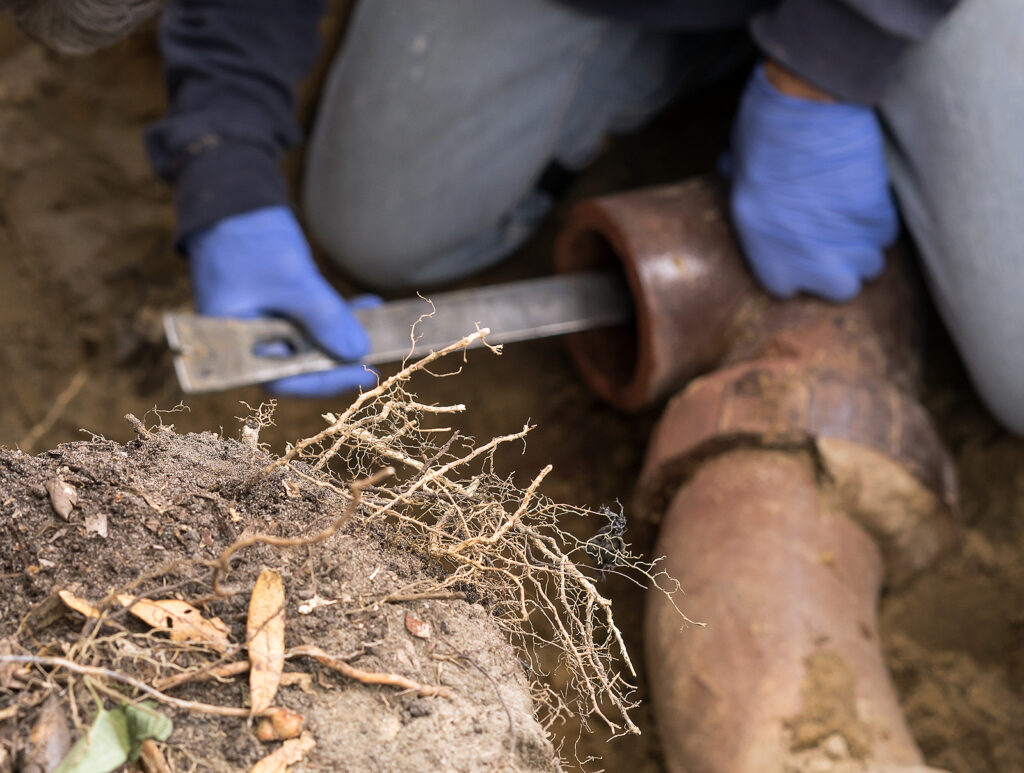
How Tree Roots Enter Commercial Sewer Lines
Tree roots and large shrub root systems grow in the top 6 to 18 inches of soil, where water, oxygen, and nutrients are most available. When conditions in the surrounding soil are dry or poor, roots extend further horizontally in search of better resources. Underground sewer pipes represent an ideal target: they provide consistent moisture, warmth, and the nutrients present in wastewater. According to the Ohio EPA and regional sewer district guidelines, root system extension of 2.5 to 3 times the tree’s height is a general rule, meaning a mature 40-foot commercial property tree may have roots extending 100 feet or more in all directions.
Roots cannot create cracks in undamaged pipe. What they do is exploit existing vulnerabilities: gaps between clay tile pipe sections whose mortar joints have deteriorated over decades, hairline cracks caused by soil settlement or freeze-thaw cycling, corroded sections of cast iron pipe, and any point where the pipe wall has been weakened by age or ground movement. Once a root hair the diameter of a thread enters through one of these openings, it thrives on the available moisture and nutrients, growing rapidly and drawing more roots toward the same entry point.
Northeast Ohio’s clay terra cotta tile pipe, which was the standard sewer lateral material installed through the late 1980s, was constructed in short sections with bell-and-spigot joints sealed with mortar. Over 30 to 50 years, those joints settle and deteriorate, providing precisely the gaps that root systems exploit. Regional plumbing and infrastructure sources identify tree root intrusion as the number one cause of sewer blockages in Northeast Ohio. The region’s high annual precipitation promotes aggressive root growth year-round, and during dry summer periods roots actively seek the consistent moisture provided by active sewer lines.
Which Commercial Properties in Northeast Ohio Face the Highest Risk?
- Properties with sewer laterals more than 30 years old, particularly those with clay tile or early cast iron pipe construction
- Buildings with mature trees or large shrubs within 30 to 100 feet of the sewer lateral route
- Commercial sites along older development corridors throughout Medina, Cuyahoga, and Summit counties where infrastructure dates to the 1950s through 1980s
- Properties that have experienced repeated freeze-thaw cycles in recent winters, which accelerate joint cracking and create new root entry points
- Buildings where drain service calls have increased in frequency over the past year or two without a camera inspection to confirm the cause
- Properties managed under the Northeast Ohio Regional Sewer District service area that have not had lateral inspections in more than 3 to 5 years
Warning Signs of Tree Root Intrusion in Commercial Sewer Lines
Root intrusion builds gradually, and early signs are often attributed to other causes until the problem is well advanced. Watch for the following indicators, particularly if more than one appears at the same time:
- Slow drains throughout the building, not isolated to a single fixture or floor
- Recurring backups in the same location that return shortly after clearing
- Gurgling or bubbling sounds from floor drains or toilets when other fixtures on the same system are in use
- Sewage odors in lower-level areas, restrooms, or near floor drains in the basement
- Unusually green or lush patches of grass or vegetation above the sewer lateral route (indicating sewage nutrient release)
- Wet spots or soft soil developing on landscaped areas along the pipe route
- Increasing frequency of drain service calls compared to previous years
- The need for drain service at progressively shorter intervals, a pattern that indicates root mass is growing back faster than it is being removed
How Root Damage Progresses Through Four Stages
Stage 1: Initial Root Thread Entry
Fine root hairs measuring fractions of a millimeter in diameter enter through joint gaps, hairline cracks, or corroded pipe sections. At this stage there is no measurable impact on drainage performance. The root presence is detectable only through a video camera inspection. This is the ideal time to intervene: the damage is fully reversible, root tissue can be killed at the entry point with chemical treatment, and the pipe wall is still structurally intact. A proactive maintenance program that includes annual camera inspection is the only reliable way to identify Stage 1 intrusion before it advances.
Stage 2: Root Mass Formation and Partial Blockage
The root threads inside the pipe develop into fibrous masses at each entry point. These masses act as nets, trapping toilet paper, grease, food debris, and other organic material flowing through the commercial sewer line. Drainage performance begins to degrade. Some fixtures drain more slowly than others, and drain service calls become more frequent. Most commercial property managers first notice a problem and seek professional help at this stage. Mechanical root cutting and hydrojetting at this stage clears the blockage and restores flow without any structural repair work.
Stage 3: Significant Blockage and Pipe Wall Stress
Root masses have grown large enough to block most or all of the pipe’s flow capacity. Sewage backs up into the building through floor drains, toilets, or utility sinks on lower levels, creating a visible emergency. As roots continue growing, they exert physical pressure on the pipe wall at each entry point. This pressure creates the conditions for structural failure at the next stage. Stage 3 requires immediate service, and follow-up camera inspection after clearing is critical to assess pipe wall condition before deciding on the appropriate long-term repair approach.
Stage 4: Structural Pipe Damage
Root pressure and continued growth crack or fragment the pipe wall at entry points, and joint separation increases beyond the original gap. In clay tile pipe, sections can partially or fully collapse under the combination of root pressure and the soil and surface load above the pipe. At Stage 4, the repair scope has expanded substantially from what Stage 1 or Stage 2 treatment would have required. The damage is no longer limited to root removal and treatment but requires camera inspection documentation, assessment for trenchless relining feasibility, and potentially excavation and pipe replacement for collapsed sections.
Diagnosing Commercial Root Intrusion With Video Camera Inspection
Video camera inspection is the only reliable method for confirming root intrusion, identifying the damage stage, assessing pipe wall condition, and determining whether treatment, relining, or replacement is the appropriate response. Ohio Buckeye Plumbing inserts a high-resolution waterproof camera into the commercial sewer line from a cleanout access point, providing live footage that shows the exact location of root entry points, the density and extent of root masses, any cracking or pipe wall compromise, and the condition of joints throughout the lateral. Our commercial video camera sewer inspection service is available throughout Northeast Ohio for both diagnostic and scheduled preventive use.
Camera inspection footage also serves as valuable documentation for property management records, insurance discussions, and contractor coordination. The Medina County Sanitary Engineers Office and NEORSD both require that licensed contractors perform sewer lateral work in their respective service areas. Our blog on how video inspections prevent unnecessary excavation and property damage provides additional detail on the diagnostic process.
Treatment and Repair Options for Commercial Root Intrusion
Early Stage: Root Thread Entry, Pipe Wall Intact
When camera inspection confirms root thread entry without significant mass accumulation or pipe wall damage, Roots Be Gone foaming treatment applied through a cleanout access point kills root tissue at the entry points and creates a chemical environment that discourages regrowth for approximately 12 months or more. This is the lowest-disruption, most cost-effective intervention and is recommended as an annual scheduled treatment for any commercial property with confirmed early-stage root presence.
Moderate Stage: Root Mass, Partial Blockage, Pipe Wall Intact
Mechanical root cutting using a cable machine equipped with a root-cutting attachment removes the root mass and restores flow. Following with hydrojetting from our commercial hydrojetting service flushes all debris and cuts any remaining fine root material from the pipe walls. A Roots Be Gone treatment after jetting kills residual root tissue at entry points. A follow-up camera inspection confirms pipe wall condition and determines whether the entry points should be sealed by trenchless relining as a permanent measure. Scheduling re-inspection within 6 to 12 months monitors the regrowth rate.
Severe Stage: Significant Blockage or Structural Pipe Damage
When camera inspection reveals cracked pipe walls, joint separation, or structural compromise, the repair scope expands beyond root removal. Trenchless epoxy pipe lining installs a seamless internal sleeve that seals all joint gaps, cracks, and entry points, eliminating future root access while extending pipe service life by 25 to 50 years. For pipes where the wall condition is too compromised to accept a liner, excavation and replacement are required. Ohio Buckeye Plumbing’s commercial sewer repair service includes both trenchless and traditional repair options, depending on pipe condition, depth, and property access constraints.
Long-Term Prevention for Northeast Ohio Commercial Properties
The most effective commercial root intrusion management combines scheduled professional maintenance with proactive monitoring. Ohio Buckeye Plumbing’s commercial preventive plumbing maintenance program can include:
- Annual video camera inspection of the main sewer lateral to identify root entry before mass develops
- Scheduled Roots Be Gone treatment applied annually to properties with confirmed root history
- Hydrojetting service on a maintenance schedule to maintain full pipe diameter and flush debris
- Monitoring documentation for property management records and insurance purposes
Proactive management prevents Stage 1 root entry from progressing to Stage 3 emergency backup and the business disruption, health code concerns, and repair costs that come with it.
What Northeast Ohio Businesses Should Know About Local Root Intrusion Risk
Tree root intrusion hits Northeast Ohio commercial properties particularly hard for several converging reasons. The clay terra cotta tile infrastructure installed throughout the commercial development corridors of Medina, Cuyahoga, and Summit counties from the 1950s through 1980s is now 40 to 70 years old, and its mortar-sealed joints have deteriorated to the point where root entry is straightforward in many locations. Northeast Ohio’s high annual precipitation, averaging more than 37 inches of rainfall per year across the region, promotes aggressive year-round root growth. And the mature urban and suburban tree canopy throughout commercial zones, from the strip mall corridors of Strongsville and Brunswick to the older commercial blocks of Akron and Cleveland’s inner ring suburbs, puts root systems within range of most commercial sewer laterals.
Our existing residential blog on how tree roots affect residential drain lines covers the same root biology from a homeowner’s perspective. For commercial properties, the stakes are higher because a sewer backup creates immediate business interruption, potential health code violations, and liability concerns that do not apply to a residential setting. The Ohio EPA and local sewer authorities including NEORSD and the Medina County Sanitary Engineers Office, require that all sewer lateral repair and connection work be performed by licensed contractors. Ohio Buckeye Plumbing maintains all required licensing and works directly with county and district authorities for permitted sewer work throughout our service area.
FAQs About Tree Roots in Commercial Sewer Lines
How do tree roots get inside a commercial sewer line?
Tree roots cannot crack undamaged pipe on their own. They exploit existing vulnerabilities: gaps between clay tile pipe sections, deteriorated mortar joints, hairline cracks from soil settlement or freeze-thaw cycling, and corroded sections of older cast iron pipe. Once a fine root hair enters through one of these openings and finds the moisture and nutrients inside the sewer line, it grows rapidly, drawing more roots to the same entry point. In Northeast Ohio, where clay tile sewer infrastructure from before the 1980s is common on commercial properties, joint deterioration over several decades provides numerous potential entry points.
What are the earliest signs of tree root intrusion in a commercial sewer lateral?
The earliest signs are subtle and easy to attribute to other causes. Drains throughout the building begin taking slightly longer to clear than they used to, particularly during or after heavy use periods. Gurgling sounds may come from floor drains or toilets when other fixtures on the same stack are used. A faint sewage odor may develop in lower-level areas or near floor drains. At this stage, there is no backup or business disruption yet, which is why early-stage root intrusion is usually only confirmed by a video camera inspection during scheduled maintenance.
How quickly can tree roots completely block a commercial sewer line?
The timeline from initial root entry to complete blockage varies by tree species, root system aggressiveness, pipe size, and how much debris the partial blockage accumulates. Aggressive species in ideal growing conditions can progress from first entry to partial blockage within one to two growing seasons. In Northeast Ohio, the combination of high annual rainfall (which promotes root growth) and aging clay tile pipe infrastructure (which provides easy entry points) means commercial properties can progress from early-stage intrusion to significant operational disruption within two to five years if not monitored.
Which tree species are most likely to intrude into commercial sewer lines in Northeast Ohio?
Trees with aggressive lateral root systems are the highest risk. In Northeast Ohio, silver maple, willow, cottonwood, poplar, American elm, and sycamore are among the most problematic species near sewer lines. These trees have extensive feeder root networks that actively seek moisture and can extend 2.5 to 5 times the height of the tree. Other common Northeast Ohio species including oak and Norway maple also pose risk, though generally lower than the most aggressive varieties. Trees within 30 to 100 feet of a commercial sewer lateral route should be considered potential intrusion sources on properties with older pipe infrastructure.
Can tree roots permanently damage the structure of a commercial sewer line?
Yes. Once roots enter a pipe, they continue growing and exerting increasing pressure on the pipe walls at the entry point. This pressure eventually cracks or fractures the pipe, particularly in brittle clay tile or deteriorated cast iron. Roots can also cause joint separation as they expand at the entry gap. In advanced cases, root pressure combined with soil load above the pipe can cause partial or complete pipe collapse. Structural damage of this type cannot be resolved by root cutting alone and requires trenchless pipe relining or full excavation and replacement.
What is the most effective way to remove tree roots from commercial sewer pipes?
The most effective immediate response is mechanical root cutting followed by hydrojetting. Mechanical cutting removes the root mass inside the pipe, and hydrojetting flushes the debris and removes any remaining root material from the pipe walls. Applying a Roots Be Gone foaming treatment after hydrojetting kills root tissue at the entry points and slows regrowth significantly. For a permanent solution, a video camera inspection after clearing determines whether the pipe can be trenchlessly relined to seal the entry points and prevent future intrusion.
Is hydrojetting safe for removing tree roots from commercial pipes?
Yes, when performed by an experienced technician with knowledge of the pipe material and condition. Hydrojetting is safe for all common commercial sewer pipe materials in good structural condition, including PVC, cast iron, and vitrified clay tile that has not been cracked or compromised. A video camera inspection before hydrojetting allows the technician to assess pipe condition and determine whether the water pressure should be adjusted for the material. Ohio Buckeye Plumbing inspects pipe condition before recommending hydrojetting on properties with older pipe infrastructure.
Do I need to remove the tree to permanently solve root intrusion in my commercial sewer line?
Tree removal is not required to resolve sewer root intrusion, though it does reduce the risk of recurrence from that specific tree. The permanent solution is repairing or relining the pipe to eliminate the entry points that roots are exploiting. A trenchless epoxy liner installs a seamless, jointless interior surface inside the existing pipe, sealing all cracks and joint gaps. With no accessible entry points, even an active root system from an existing tree cannot re-enter the sewer line. Roots Be Gone treatment is also recommended as a scheduled preventive measure even after lining.
What is trenchless pipe lining and is it appropriate for commercial sewer root damage?
Trenchless pipe lining installs an epoxy-saturated liner inside the existing sewer pipe through cleanout access points, without requiring excavation of the pipe route. The liner cures in place and creates a seamless, smooth interior surface that eliminates joint gaps and seals any cracks in the pipe wall. For commercial properties where excavation would disrupt parking lots, landscaping, or building foundations, trenchless lining is often significantly more cost-effective than traditional replacement. It is appropriate when the pipe retains enough structural integrity to support the liner installation.
How far can tree roots travel underground to reach a commercial sewer line?
Tree root systems typically extend 2.5 to 3 times the height of the tree in all directions, and some species extend even further under drought conditions. A 40-foot tree can have root systems extending 100 feet or more from the trunk in ideal conditions. During dry periods, roots actively seek out the consistent moisture source provided by a sewer line, traveling longer distances than they would in normally moist soil. Commercial property owners should consider any mature trees within 50 to 100 feet of the sewer lateral route as potential intrusion candidates, particularly during dry summers.
What is a Roots Be Gone treatment and how long does it work in commercial applications?
Roots Be Gone is a professional-grade copper sulfate foaming product applied to sewer lines through a toilet or cleanout access point. The foam expands to contact all interior surfaces at the point of application, killing root tissue it contacts and leaving a chemical residue that discourages regrowth for approximately 12 months or more. For commercial applications, Ohio Buckeye Plumbing applies this treatment as part of a combined service following root cutting and hydrojetting, and recommends annual reapplication as part of a preventive maintenance program for properties with confirmed root intrusion history.
How often should a commercial property inspect for tree root intrusion?
Commercial properties with older clay tile or cast iron sewer infrastructure, mature trees on the property or along the sewer lateral route, or a history of drain service calls should schedule video camera sewer inspections annually. Properties on newer PVC infrastructure with no significant tree risk can typically extend the inspection interval to every 2 to 3 years. For commercial properties where sewer failure would cause significant health code concerns, business interruption, or liability, proactive annual monitoring is the more responsible approach. Ohio Buckeye Plumbing includes camera inspection as part of its commercial preventive maintenance programs.
Does commercial property insurance cover tree root sewer line damage?
Most standard commercial property insurance policies do not cover damage from gradual tree root intrusion, which insurers typically classify as a maintenance issue or gradual deterioration rather than a sudden, accidental event. Some carriers offer optional sewer line endorsements or inland marine coverage that may provide partial protection. Commercial property owners and managers should review their specific policy language and consult their insurance broker. Ohio Buckeye Plumbing recommends keeping records of all sewer maintenance, camera inspections, and treatment services as documentation of proactive maintenance that may be relevant in coverage discussions.
What should a commercial property manager do when sewage backs up into the building?
Stop all water use in the building immediately to prevent additional sewage from backing up through the affected drains. Keep employees and customers away from affected areas. Contact Ohio Buckeye Plumbing at (440) 283-9377 for 24/7 commercial emergency plumbing service. Do not attempt to clear the backup with chemical drain products, as this may worsen conditions in a system with a significant root mass blockage. Our commercial emergency team arrives with root-cutting equipment, hydrojetting capability, and camera inspection tools to diagnose and restore flow as quickly as possible.
How does Ohio Buckeye Plumbing approach tree root intrusion in commercial sewer lines?
Ohio Buckeye Plumbing follows a diagnostic-first protocol for commercial root intrusion. We start with a video camera inspection to confirm root presence, identify the stage of damage, and assess pipe wall condition. Based on the footage, we present clear repair options with upfront pricing before any work begins. We perform mechanical root cutting, hydrojetting, and Roots Be Gone treatment as the standard service sequence, and recommend trenchless relining or pipe replacement when structural damage is confirmed. We also offer scheduled commercial preventive maintenance programs that include annual inspections and treatments to prevent root intrusion from reaching the operational impact stage.
When to Call Ohio Buckeye Plumbing About Commercial Root Intrusion
Ohio Buckeye Plumbing’s commercial plumbing team brings the camera inspection equipment, root-cutting tools, hydrojetting capability, and structural repair expertise to address tree root intrusion at every stage for Northeast Ohio businesses. We are licensed under Ohio OCILB standards, fully insured with general liability and workers’ compensation coverage, and hold an A+ BBB accreditation. We operate 24/7 for commercial emergencies. Read verified reviews on Google and Angi before scheduling. Every commercial service begins with a diagnostic-first evaluation and upfront pricing before any work begins.
Schedule a Commercial Sewer Camera Inspection in Northeast Ohio
Do not wait for a full sewer backup to discover that tree roots have been growing in your commercial sewer line for years. Ohio Buckeye Plumbing’s commercial drain cleaning and commercial sewer repair services include camera inspection, root cutting, hydrojetting, Roots Be Gone treatment, and trenchless pipe lining for Northeast Ohio businesses of all sizes. Call (440) 283-9377 today for a free consultation and to schedule a diagnostic camera inspection. We are BBB-accredited, fully insured, and available 24/7 for commercial plumbing emergencies throughout Greater Cleveland, Medina County, Akron, and all of Northeast Ohio.